The National Museum of Korea Glows in Pink
Space-EX | Seoul’s Landmark Spaces Transform into K-POP Stages
BTS Comeback at Gwanghwamun After a 3-Year, 9-Month Hiatus
Following a long 3-year, 9-month hiatus, BTS marked their definitive return as a full group. They strategically selected Gwanghwamun—the historic heart of Seoul—as the primary stage for this landmark comeback. The members underscored the location’s significance, stating, “We wanted to show you where we started.” In this context, Gwanghwamun was more than a stage backdrop; it served as a symbolic space to project the group’s identity. By launching their return from this historic site, BTS reinforced a powerful global message: that their artistic roots remain firmly planted in Korea.
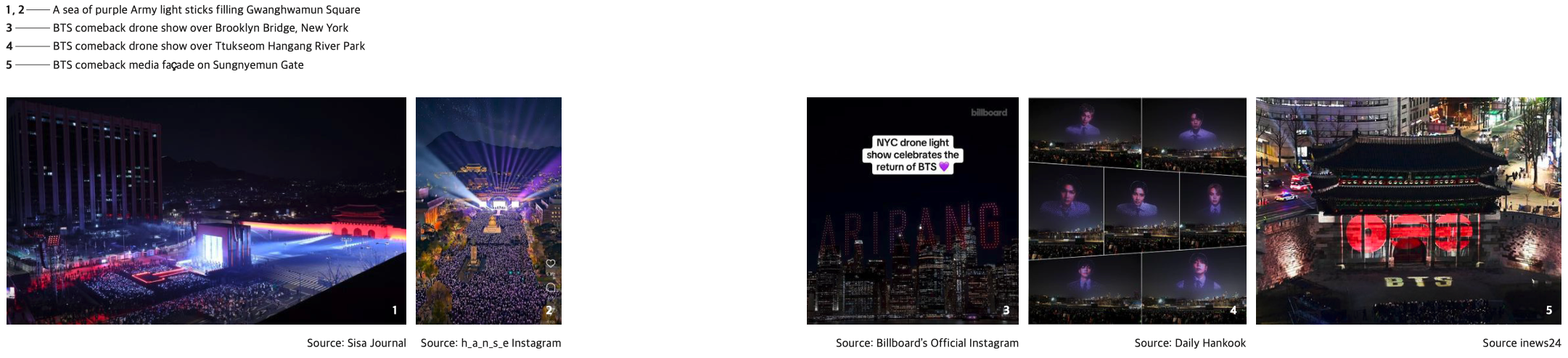
Leading up to the performance, large-scale teasers were deployed across iconic landmarks in New York and Seoul. The campaign launched on March 18 with a massive drone show above the Brooklyn Bridge, illuminating the night sky with the question, “NEW YORK, WHAT IS YOUR LOVE SONG?” while officially announcing the group’s comeback date. Two days later, on March 20, the momentum shifted to Seoul’s Ttukseom Hangang River Park. For 15 minutes, approximately 2,000 drones painted the night sky in vibrant red and blue, forming the Korean national flag. As the silhouettes of the seven members appeared one by one, the cheers from the massive crowd echoed across the river. This public event, accessible to all without reservation, effectively rebranded the Seoul skyline in the signature colors of BTS, driving anticipation to a fever pitch. That same evening, the stone fortress walls of Sungnyemun Gate (National Treasure No. 1) were transformed into a media fa ade for the first time in their history. The projection featured silhouettes of the members carrying traditional lanterns across the fortress walls, followed by the vivid red “Arirang” logo. This spectacle further fueled the excitement for the following day’s performance at Gwanghwamun. From New York to Seoul, and from the Hangang River to Sungnyemun, this series of synchronized events solidified BTS’s return as a global cultural phenomenon before the first note of the concert even began.
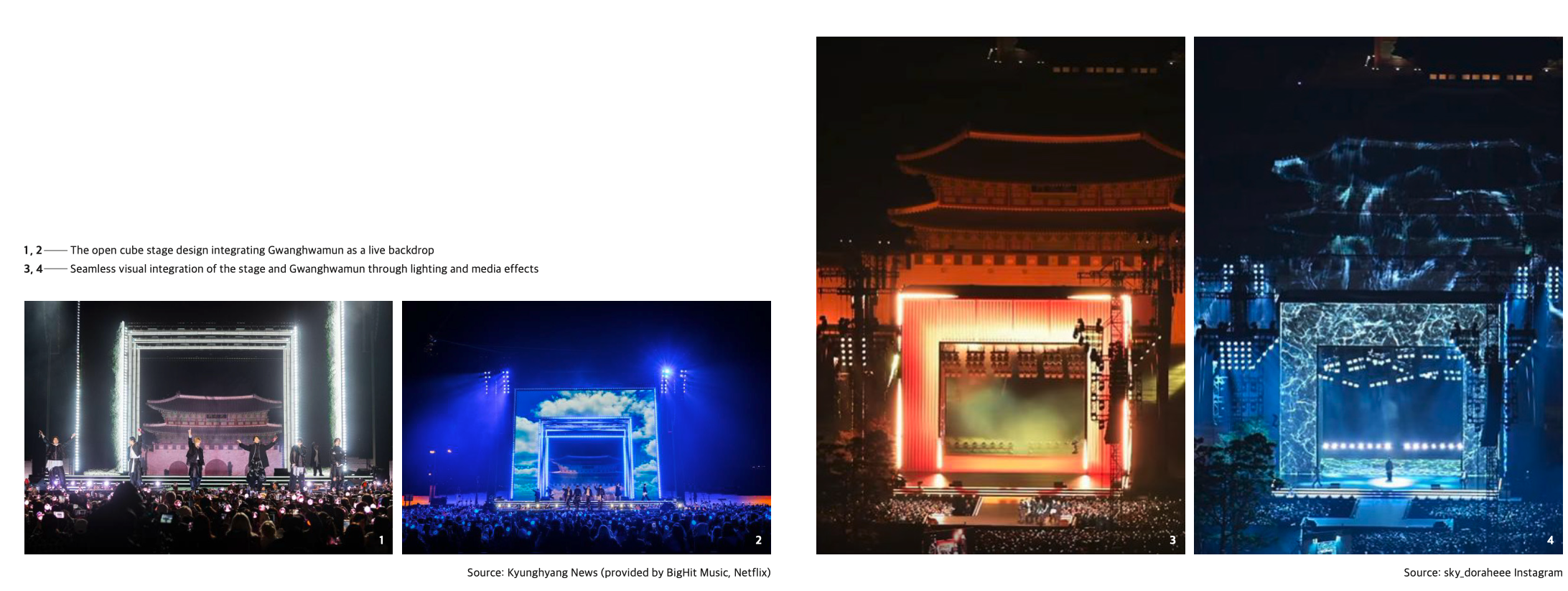
The stage design for the Gwanghwamun comeback prioritized seamless spatial integration, ensuring the artists were embedded within the historic landscape without obstructing its architectural significance. To achieve this, a custom “open cube” stage was engineered. Unlike conventional stages that utilize massive LED walls to block the background, this structure remained entirely open at the rear, allowing the panoramic vista of Gwanghwamun to serve as the primary live backdrop. By employing slim frames rather than thick pillars, the design created a continuous line of sight from the artists to the historic Gwanghwamun Woldae. In this setting, the landmark functioned as an active participant in the performance, allowing tradition and modernity to coexist within a single, unified frame.
The pinnacle of the production was the use of the “King’s Path”—a 500-meter path stretching from Geunjeongjeon Hall in Gyeongbokgung Palace to the Gwanghwamun Woldae—as the opening processional route. Instead of creating a standalone set, the production framed the stage as a seamless continuation of the historical landscape. Moreover, the strategy focused on rediscovering existing heritage rather than adding new structures. By embedding BTS’s musical narrative within this historical context rather than using tradition as a mere prop, the production successfully visualized the group’s deep connection to their Korean cultural roots. By minimizing physical installations and transforming historical assets into the stage itself, the campaign cleverly leveraged the symbolic significance of a national landmark, creating a unique aesthetic where the past and the present converge.
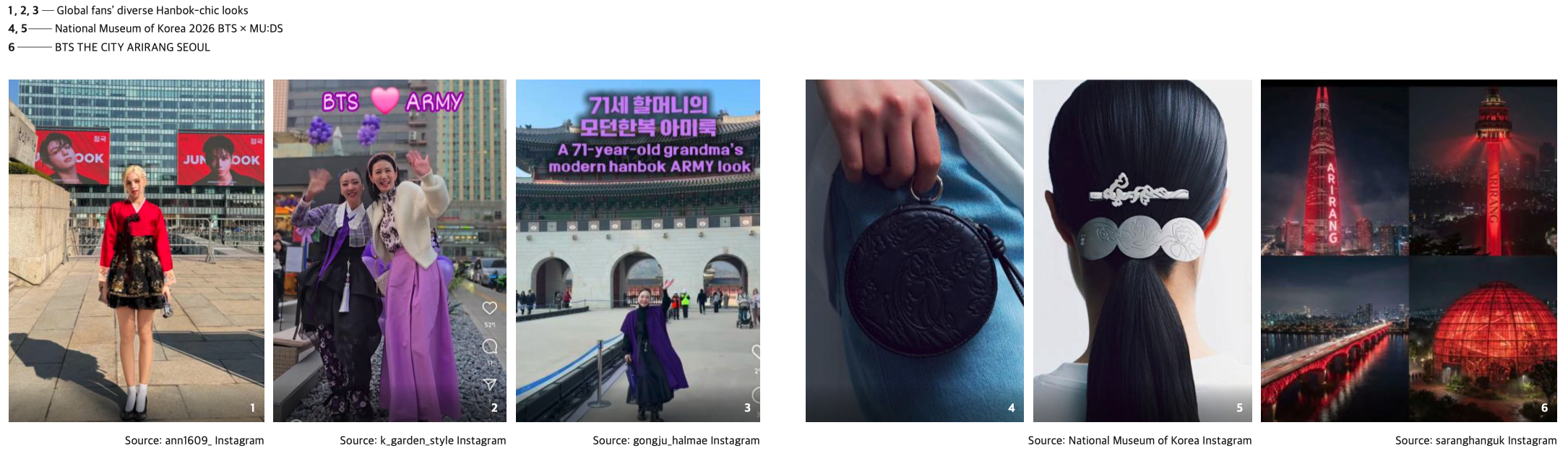
One of the most compelling phenomena was the fan-driven “Hip-Traditional” fashion. Reports from CNN Style and Korea JoongAng Daily noted that local Hanbok (Korean traditional dress) rental shops were flooded with fans adopting traditional attire as their primary dress code. Fans went beyond simply wearing Hanbok; they showcased “Hanbok-chic” look by accessorizing light sticks with purple norigae (traditional Korean accessory) or seamlessly mixing modern streetwear with traditional skirts. One fan from the U.S. made a custom red-and-white Hanbok jacket to match the album’s concept—showing how fans are actively engaging by deeply understanding the artist’s messages and turning them into their own personal style. This scene at Gwanghwamun demonstrated how artist IP, when embraced by a creative fandom, can transform tradition from a static relic into a vibrant, modern fashion language.
Centered on the Gwanghwamun performance, Seoul was transformed into a massive cultural theme park. The Ministry of Culture, Sports, and Tourism and five national cultural institutions worked together to create touchpoints for global fandom to engage deeply with Korean heritage. The National Museum of Korea expanded English-language resources for iconic artifacts like the Pensive Bodhisattva and launched “MU:DS,” a collaborative merchandise line with HYBE—reimagining traditional assets as modern consumer products. Simultaneously, the National Folk Museum of Korea hosted “K-Playground,” allowing fans to experience traditional games featured in Run BTS!, alongside “K-Heung Hanmadang,” which showcased the traditional instruments and Hanbok aesthetics from the group’s music. By turning on-screen virtual content into tangible physical experiences, this initiative effectively lowered the psychological barriers to traditional culture. These public sector initiatives harmonized with HYBE’s “BTS THE CITY” project, transforming the entire city into an expansive exhibition space. This urban curation strategy—stretching from the Sungnyemun media facade to the Hangang River drone shows—represented a multidimensional integration of national infrastructure and private brand strategy. By extending the brand experience across the city, the campaign effectively directed the global fandom’s flow toward major landmarks beyond the concert venue.