The Concept of GEO and How It Differs from SEO
Issue Discovery | Beyond SEO: GEO
GEO involves understanding how AI learns and recommends content—and strategically optimizing it to boost brand visibility across AI platforms. To effectively apply this strategy, it’s important to understand how GEO is fundamentally different from SEO—and how the digital environment is changing around it.
GEO: Concept and Example
GEO (Generative Engine Optimization) is the practice of structuring content so that generative AI platforms can easily access, accurately interpret, and recognize it as a reference when generating responses to user queries. At its core, GEO is about optimizing content—whether it’s a brand, product, concept, person, or idea—to increase its visibility in answers generated by generative engines like ChatGPT, Google AI Overviews, and Perplexity. For example, consider a pizza shop in New York. If generative AI typically recommends visiting Central Park or the Statue of Liberty when asked about things to do in the city, the goal of GEO would be to position “New York-style pizza” as a must-try experience—making it more likely that the shop appears in AI-generated suggestions.
Example
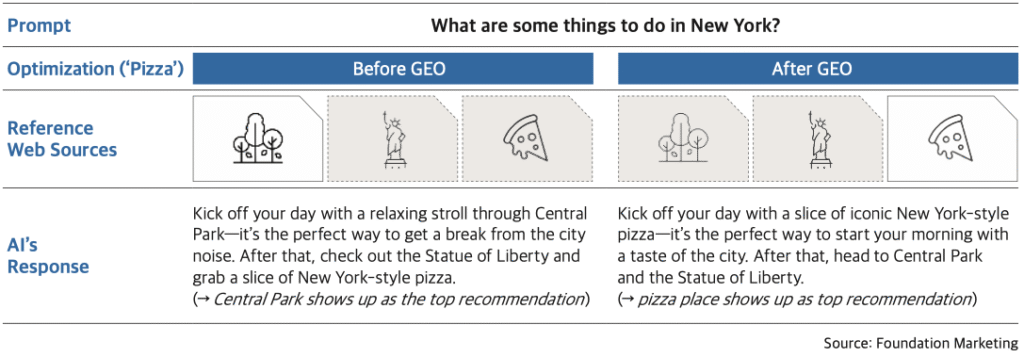
SEO vs GEO
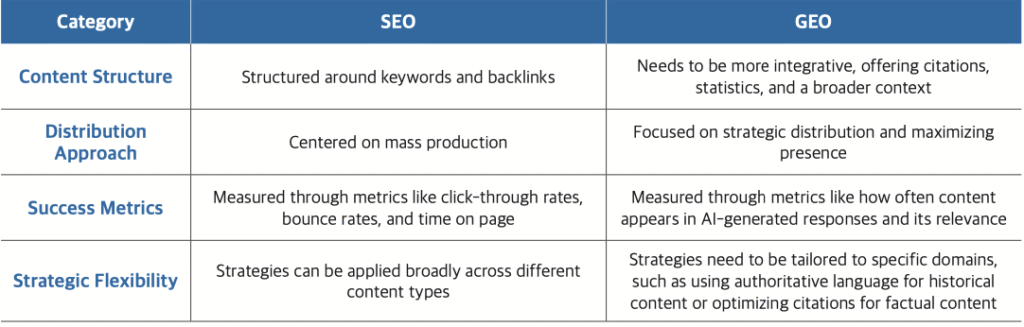
When it comes to implementation, GEO often shares or builds upon the methodologies used in SEO (Search Engine Optimization), which typically targets traditional search engines like Google. In today’s landscape, where search engines and generative AI platforms coexist, SEO and GEO should be used together to maximize impact and drive synergy. However, GEO differs fundamentally from SEO in its objective. While SEO is designed to drive “link clicks,” GEO aims to have your content “included directly in AI-generated responses.” Additionally, SEO focuses on “keyword optimization,” whereas GEO emphasizes improving content “credibility” and “structure” to increase the likelihood of being selected as a reference. These differences call for a shift in how marketers approach digital strategy, content creation, and content distribution in the AI-driven era.
Key Differences Between SEO and GEO