

Various Developments in Mobility
Trend Hunter | CES2025 – Dive in
Digital health took center stage at CES 2025, with four out of the 19 Best of Innovation recognitions
awarded to healthcare-related innovations. As the industry lacks a clear dominant leader, it provided a
unique opportunity for startups to showcase remarkable achievements.
Digital Health Devices Enhancing the Convenience of Healthcare
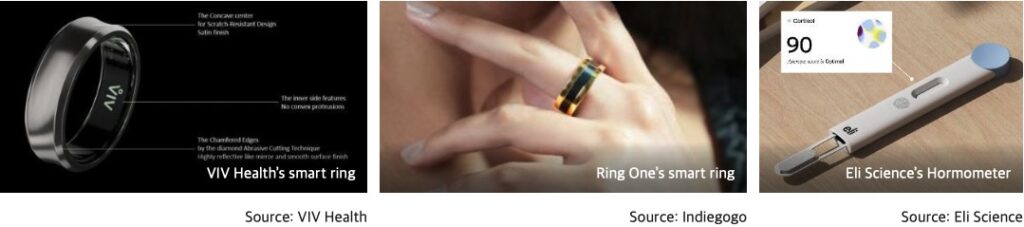
Wearable healthcare devices are evolving beyond the traditional smartwatch form and shifting towards
smart rings. While smartwatches primarily serve as companions to smartphones, smart rings are designed
to concentrate solely on health-related features. Seven different smart rings, each with unique strengths
and specifications, were showcased at CES 2025. Among them, VIV Health, the only Korea-based company
in the smart ring category, stood out by integrating generative AI into its product. The smart ring analyzes
sleep patterns and generates personalized sleep aid sounds. India-based Ring One showcased its smart ring,
capable of monitoring six health indicators, including temperature, respiratory rate, heart rate, and blood
pressure. It also features a payment function and a design that resembles a fashion brand ring. Canadian
healthcare company Eli Science garnered significant attention with its saliva-based hormone tracking device,
which was named a Best of Innovation winner. The device is easy to use: a test tip collects a saliva sample
when placed in the user’s mouth, with results displayed on a connected app. Currently, it can track cortisol
and progesterone levels to help manage stress and menstrual cycles. The company plans to expand the
device’s capabilities to track additional hormones in the future, generating anticipation for its potential to
prevent chronic illnesses related to hormonal imbalances.
Out-of-the-Box Approaches to Treatment
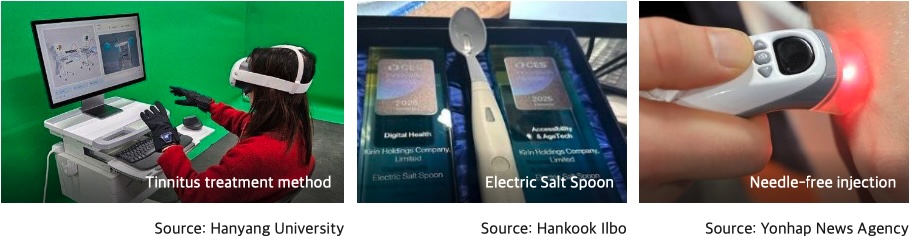
In the field of digital health, solutions that challenged traditional norms captured significant attention at CES
2025. Play Lab at Hanyang University in Korea introduced an innovative digital therapy for tinnitus, moving
away from traditional medication-based treatments. Their game-like therapy combines auditory, visual, and
tactile feedback systems using virtual reality (VR) technology. By “eliminating” tinnitus particles in a virtual
environment, this cognitive therapy approach helps relieve tinnitus symptoms. This earned Best of Innovation
recognition at CES 2025.Kirin Holdings, a Japan-based company, proposed a unique solution to low-salt diets
through its Electric Salt Spoon, rather than relying on changes in cooking. The spoon emits a mild electric
current that concentrates sodium molecules in food directly on the tongue, enhancing the perception of
saltiness. This device offers a convenient way to adhere to a healthier diet.While the word “injection” often
brings to mind sharp needles, Dutch healthcare company FlowBeams unveiled an innovative needle-free
injection technology. The device delivers a high-precision liquid microjet directly into the skin to administer
medication. This approach, which is thin and extremely fast, is painless and eliminates the risks associated with
traditional syringes, such as accidents, hygiene concerns, and the environmental burden of needle disposal.
© Copyright 2025 – Innocean – Privacy