

Main Exhibitions at SIBF 2025
Space-EX | The Last Resort: Seoul International Book Fair 2025
Designed with the concept of a seed vault in mind, the “Last Resort” exhibition portrayed books as symbolic seeds—our last resort that we can rely on in times of crisis.
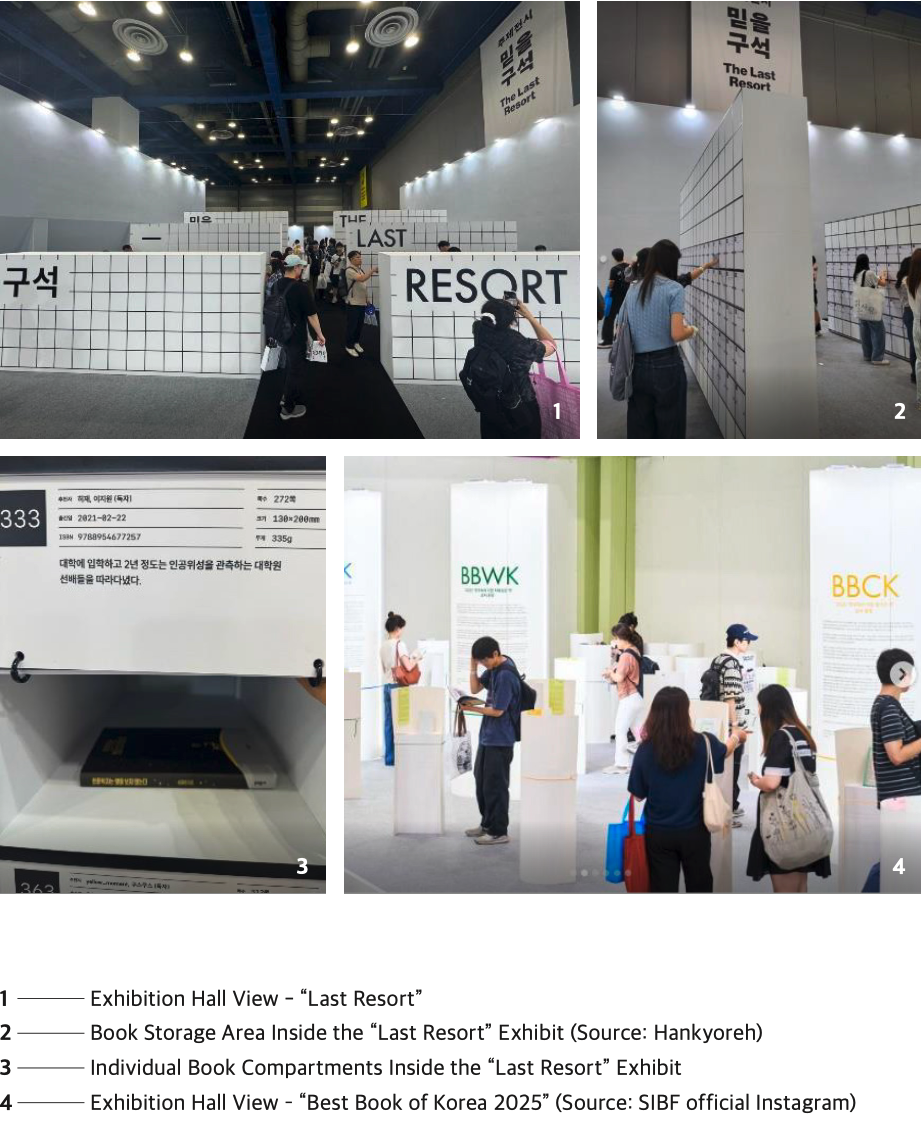
Among the must-visit exhibitions were the “Last Resort” and the “Best Book of Korea 2025,” the main exhibitions curated by the SIBF. The Last Resort exhibition greeted visitors right at the entrance with white, grid-patterned walls arranged in neat rows. A closer look revealed that these walls are composed of storage compartments. On each compartment, visitors could find key information about a featured book—such as the recommender, publication date, dimensions, page count, the ISBN(International Standard Book Number), and a memorable line. Inside each compartment sat the book itself, waiting to be discovered. The exhibit draws inspiration from the concept of a seed vault—a structure designed to preserve life and provide hope for those who survive a potential global catastrophe that may one day affect humanity as a whole. In this case, however, the seeds are books: something to hold onto, to rely on, even in the face of disaster. The fair curated over 400 book recommendations from writers and readers, showcasing them as trusted “last resorts.” The exhibition also featured a “Plant Your Last Resort” zone, where visitors were invited to write down and symbolically plant their own “last resort” after browsing the book-filled storage units. At the end of the exhibition, the visitors encountered the “Last Resort Pickup Station,” where they were offered actual seeds to take home. The other main exhibition, “Best Book of Korea 2025,” spotlighted 40 outstanding titles across four themes: Design, Children, Pleasure, and Wisdom, with 10 titles selected in each category. The space was divided into four themed zones, each anchored by a pillar that explained the selection criteria and featured judges’ commentaries. Around these were small desks where visitors could stand and flip through the selected books. One notable drawback, however, was that only a single desk was provided per title—an arrangement that felt limiting, especially given the high visitor turnout.