Limitations of Performance Advertising
Issue Discovery | The Multiplier Effect of Brand Advertising
While performance advertising offers clear benefits in terms of efficiency, relying solely on it can lead to a vicious cycle of slowing growth due to its structural limitations.
Structural Limitations of Performance Advertising
Limited Pool of Customers and Declining Conversion Rates
Performance advertising primarily targets those who are most likely to respond immediately, typically in-market customers who are already considering a purchase. However, the issue lies in the fact that this segment represents only a small fraction of the total potential customer base. In the B2C market, the proportion of in-market customers is already limited, and in the B2B market, they account for only 5% of the total audience. Beyond the small pool of potential buyers, repeated exposure to performance advertising can lead to customer attrition. When the same audience is continuously bombarded with ads even after completing a purchase, the effectiveness of the advertising decreases.
Rising Advertising Costs and Customer Acquisition Cost (CAC)
The bidding-based nature of digital advertising platforms such as Google and Meta’s Facebook means that advertising costs, including cost-per-click (CPC) and cost-per-action (CPA), rise as competition increases. As a result, it becomes increasingly difficult to maintain the same ROI with previous budget levels.
Lack of Brand Competitiveness
Performance marketing primarily emphasizes promotional messaging. When brands rely solely on performance advertising without investing in brand-building efforts, consumers begin to perceive their products only in terms of price and promotions, rather than associating them with the brand itself. This weakens brand loyalty and reduces awareness of brand value, resulting in a structure where once performance advertising stops, sales decline rapidly.
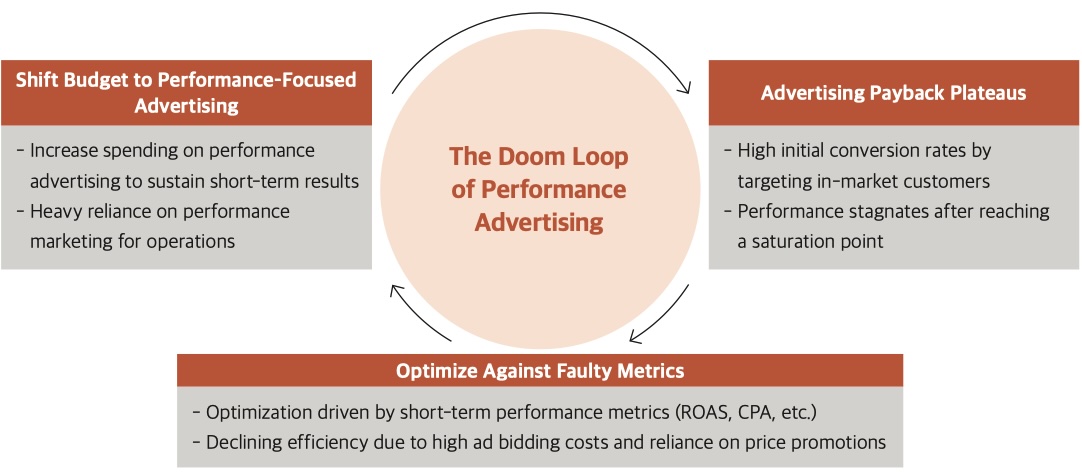
The Doom Loop
The most critical consequence of these limitations is the vicious cycle that brands can fall into, where performance-driven growth stagnates and becomes unsustainable. This pattern is often referred to as the “doom loop” (WARC, 2025).
When advertising-driven revenue declines, companies often optimize their ad budgets based on short-term performance metrics. However, as advertising efficiency continues to deteriorate, brands respond by increasing ad spend to compensate for the decline. While this temporarily boosts sales, it fails to create sustainable growth, and as the limitations of performance advertising resurface, revenue stagnates once again. This repetitive cycle—the doom loop—illustrates one of the biggest pitfalls of performance advertising.