

Imbalanced Advertising Strategies and Growth Slump
Issue Discovery | The Multiplier Effect of Brand Advertising
Many companies approach marketing with a “brand advertising vs. performance advertising” mindset, often prioritizing performance marketing as their primary strategy. However, relying solely on performance marketing—or placing it at the center of an advertising strategy—can lead to stagnated growth over time.
Brand Advertising vs. Performance Advertising
Brand-building advertising focuses on communicating a company’s philosophy and values, imprinting the brand in consumers’ minds. It is typically conducted through legacy media channels with the goal of building long-term brand awareness and loyalty. On the other hand, performance advertising is designed to drive immediate consumer actions and is measured through quantifiable metrics such as conversion rates. Among the two, performance advertising has become increasingly dominant over the past decade, as it provides quick feedback on ROI and allows for cost optimization, particularly with the rise of digital advertising platforms. As a result, many brands have structured their advertising strategies around maximizing short-term performance. Even today, marketers continue to allocate more budget to performance advertising rather than brand-focused advertising.
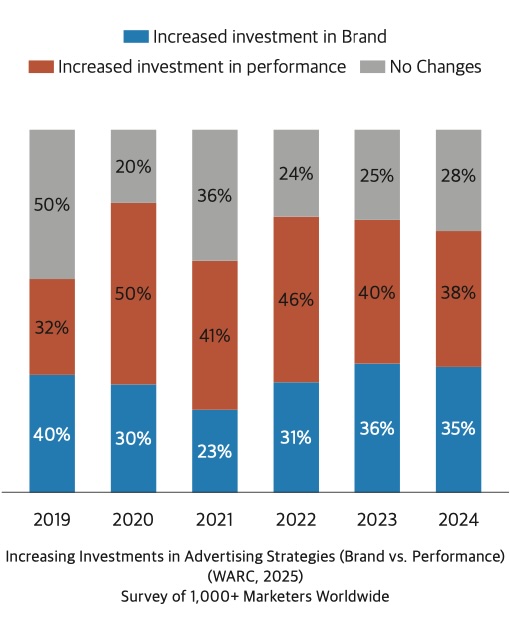
Growth Slump from Relying Solely on Performance Marketing
A performance-focused advertising approach can deliver immediate impact, making it an attractive strategy for many brands. However, when it comes to long-term brand and business growth, relying solely on performance advertising can eventually lead to stagnation. In particular, startups and e-commerce companies that need to optimize their low advertising budgets often depend heavily on performance advertising, yet they struggle to sustain growth over time. This limitation is also evident in the cases of global sports brands. Under Armour’s CEO, Kevin Plank, acknowledged that the company focused too much on driving sales in its $500 million marketing budget rather than fostering a meaningful connection with consumers. As a result, the company failed to fully feel the impact of its marketing efforts (Seeking Alpha, 2024). Similarly, Nike, in its transition to a direct-to-consumer model, initially prioritized performance marketing, only to see its stock prices drop. This prompted the company to shift its focus back to brand-building efforts (The Rebooting, 2024). Adidas followed a similar pattern, having heavily invested in performance advertising but later recognizing its limitations in driving sustained long-term growth. Since 2019, the company has adjusted its strategy, emphasizing brand-building rather than relying on price cuts to boost sales (Marketing Week, 2019).