

Entrance Cases by Industry - Automotive
Issue Discovery | A Wave of Chinese Brands Is Making Its Way In
In line with the shifting trends of the automotive industry, Chinese EVs are leading the charge into the
Korean market. Each brand is leveraging its unique strengths to make inroads, putting the Korean EV
market and domestic manufacturers on high alert.
BYD: An EV Giant Takes on Korea with Affordability
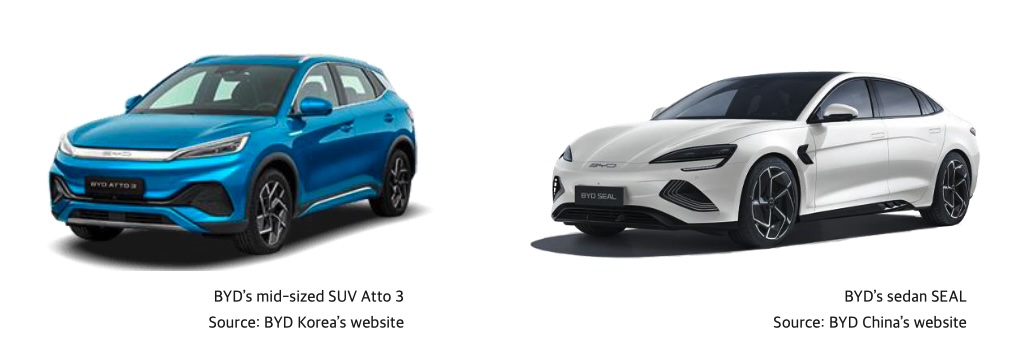
BYD, China’s leading EV manufacturer, boasts a significant share of the global EV market. Officially launching
in Korea in January 2025, BYD is targeting the Korean market by establishing a robust offline distribution
network through dealership agreements with six of Korea’s largest dealers, including DT Networks, Samchully
EV, and Vision Mobility. Additionally, the company organized test-driving events to give Korean consumers
an opportunity to experience the cars firsthand and assess their quality. Maximized price competitiveness is
another key pillar of BYD’s strategy. Its first model in Korea, the Atto 3, is priced at KRW 31.5 million without
subsidies—up to KRW 10 million cheaper than Hyundai Motor’s Kona Electric (KRW 41.42 million) or IONIQ
(KRW 47 million). Reports suggest that around 180 units of the Atto 3 were sold on the first day of pre-
orders.
BYD’s focus on affordability is poised to disrupt the Korean EV market, which has been grappling with the “EV
chasm,” while also hinting at the onset of full-fledged competition with established car manufacturers.
Zeekr and Xpeng: Poised to Enter Korea with Premium Quality and Innovative Technology
Beyond BYD, a variety of Chinese EV brands, including Zeekr and Xpeng, are actively exploring opportunities
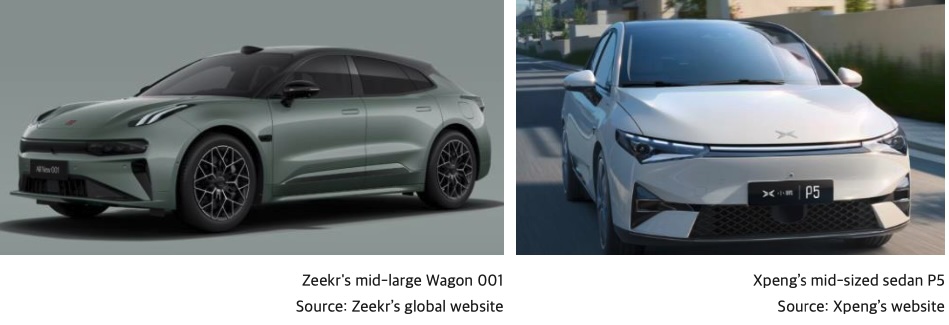
to enter the Korean market. Zeekr, a premium EV brand under the Geely Group, positions itself as a high-end
option. It plans to target the Korean market with premium models that combine trendy designs and cutting-
edge technology. Meanwhile, Xpeng aims to appeal to Korean consumers by emphasizing its innovative
automated driving technology and AI integration.
Adding to the mix, Xiaomi recently established a Korean branch, listing automotive as one of its intended
business sectors alongside smartphones and home appliances. This move indicates Xiaomi’s preparation to
enter the automotive industry, leveraging its comprehensive ecosystem.
Chinese EV brands are striving to carve out their place in the Korean market using diverse strengths and
strategies. Their entry is expected to intensify competition in the Korean EV market while offering consumers
a broader range of options.
© Copyright 2025 – Innocean – Privacy